
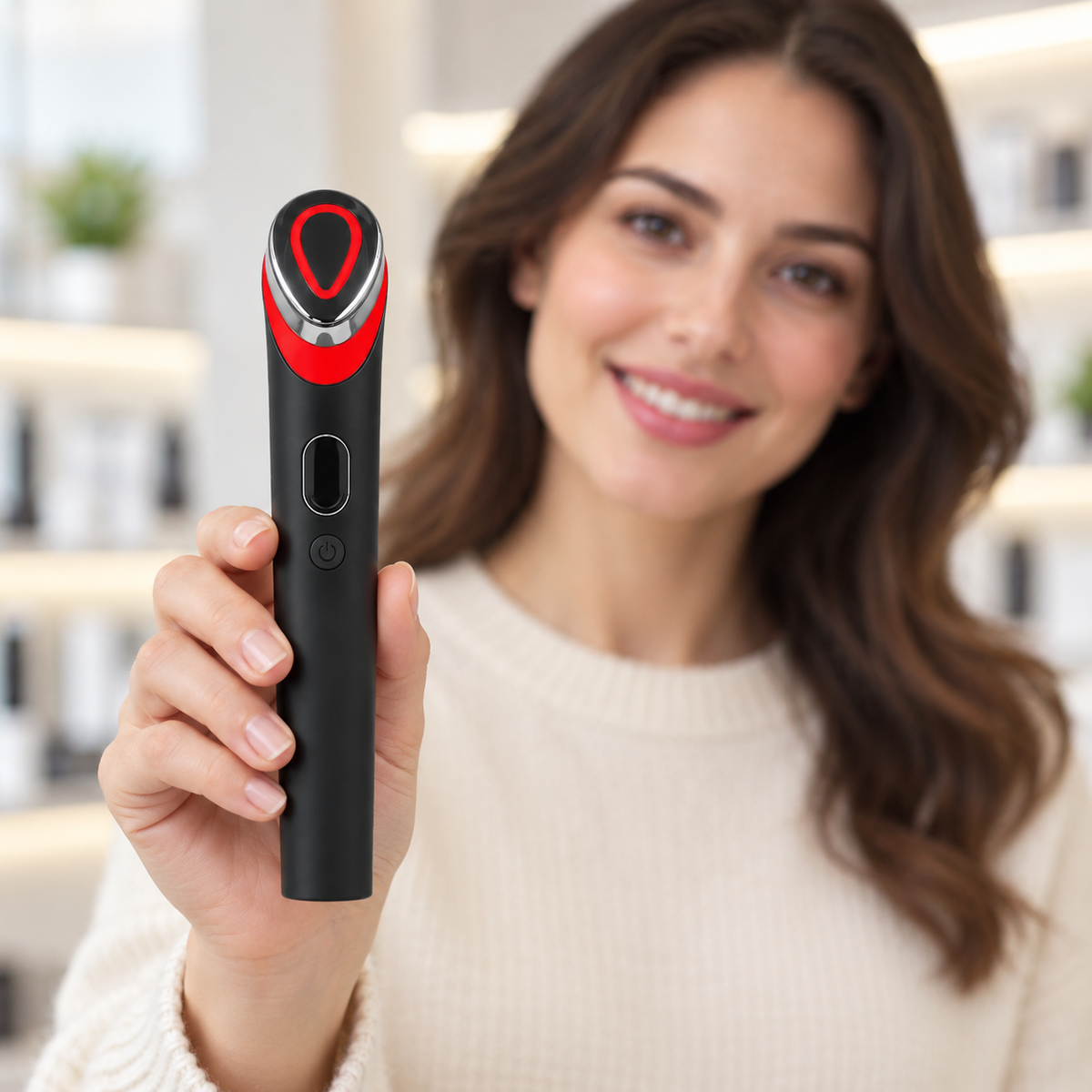
A handheld LED wand may catch your eye when your dressing table is already busy. The useful question is how that equipment would fit into the space you actually have. Start with handling, controls and accessories, then compare the format with a face mask rather than judging the purchase by an impressive product photograph.
LUMERA's Booster Pro LED Facial Light Therapy Wand is a compact handheld device with a teardrop-shaped applicator. Its listing describes a one-button control, an intensity display and USB-C charging with a cable included. Those are equipment features; they do not provide a treatment technique or a reason to use it around the eyes.
Map the surface before adding equipment
Draw a quick rectangle representing your dressing table. Mark the products, mirror and everyday objects already there. Leave ordinary working space visible in the drawing. This makes it easier to see whether another piece of equipment would add clutter or have a clear place.
A photograph can suggest a compact format without supplying exact storage dimensions. If the available space is tight, ask for the device and accessory measurements rather than guessing from the hand shown in an image. Keep the product name beside the answer so it cannot be confused with another wand.
Think about handling as a preference
A handheld format asks you to hold equipment. That may suit your preference, or it may be the feature that makes you compare another arrangement. This decision is about the form of the product, not a promise that hand movement creates a particular result.
Do not infer a contact technique from the teardrop head. The actual model instructions need to describe permitted placement and operation. If a demonstration involves a cream, a sensitive area or a different brand's device, it should not silently become guidance for this model.
Read the controls as controls
A one-button design and intensity display give you information to investigate. Ask how the supplied controls identify modes, what the display represents and where that information is explained. A low-looking number is not automatically a safe starting setting, and a higher number is not evidence of better results.
The listed USB-C charging arrangement also belongs on the information sheet. Confirm the delivered charging instructions and complete included-parts list. A cable being listed does not establish every possible charging accessory or make any USB power source appropriate.
Compare what changes with a mask
The 7 Colours LED Face Mask is a separate hands-free face format with listed touch controls, timer and USB charging. Its strap wording needs clarification. A mask comparison is useful if your main question is whether you want to hold equipment or investigate a wearer-centred arrangement.
The Silicone LED Facial Mask with Neck Cover adds a face-and-neck set with genuine Black Set and Green Set variants. It is another physical format to compare, rather than an automatic upgrade from a wand. More components can create a different storage decision without establishing a superior outcome.
Try a compact-table example
Imagine a shopper whose small table holds a mirror, a cream and a jewellery tray. They sketch the surface and realise accessories matter as much as the handheld device. Their next question concerns the complete stored set, rather than just the length of the wand.
Another shopper finds that handling equipment is the key preference and leaves mask options on a separate shortlist. Both are hypothetical purchase exercises. Neither treats compactness as proof of comfort, clinical performance or individual suitability.
Use the LUMERA wand collection to keep the comparison tied to the correct product. A clear space plan and a reason for preferring handheld equipment can make the shortlist useful before you begin reading every feature. Leave any unresolved dimension or operating question visible until it has a specific answer.

Leave a comment
This site is protected by hCaptcha and the hCaptcha Privacy Policy and Terms of Service apply.